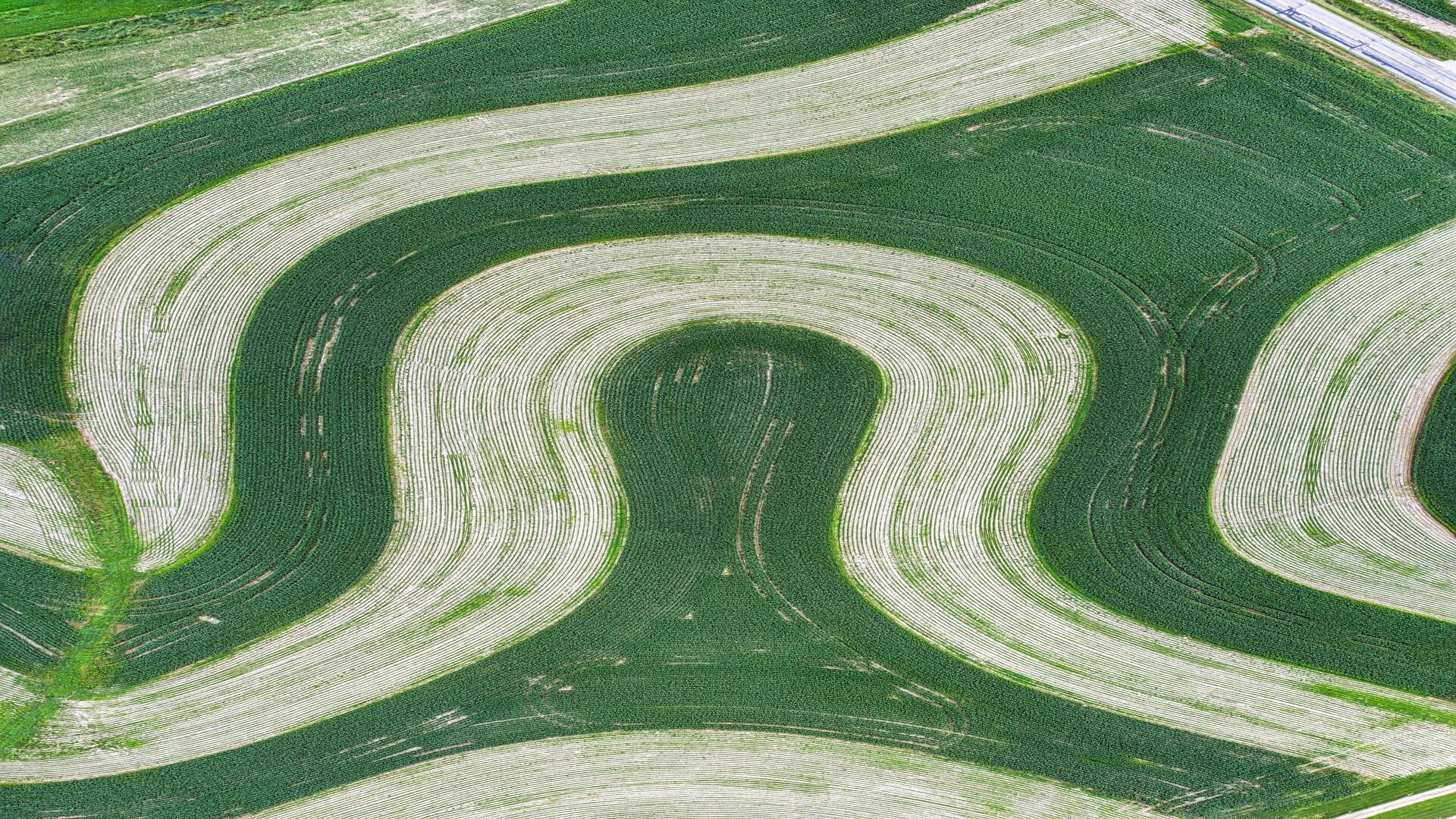
As the urgency to mitigate climate change intensifies, one solution attracting increasing global attention is soil carbon farming — a method that enhances carbon sequestration in agricultural soils through improved land management practices. From cover cropping and conservation tillage to rotational grazing and agroforestry, these techniques promise both environmental and economic benefits. But how much of that promise is grounded in scientifically verified outcomes?
A recent Q&A from Yale Environment 360 sheds light on this question, based on a new report authored by Mark Bradford, Professor of Soils and Ecosystem Ecology at Yale, and Emily Oldfield, Senior Scientist at the Environmental Defense Fund. The report, a collaboration between Yale’s Applied Science Synthesis Program and the Environmental Defense Fund, does not simply evaluate soil carbon farming’s effectiveness — it digs into how we measure, monitor, and verify its climate claims.
The Promise: Up to 5 Billion Metric Tons of CO₂ Potential
Current estimates suggest that sustainable land management could sequester as much as 5 billion metric tons of CO₂-equivalent annually between now and 2050 — roughly 10% of global emissions. This projection makes soil carbon farming one of the most potentially scalable natural climate solutions. However, despite these ambitious projections, soil carbon farming represents only a small fraction of global carbon market activity.
Why the disconnect? The problem lies not so much in the techniques themselves, but in the ability to prove their impact with scientific rigor.
The Problem: Weak Measurement, Monitoring, Reporting, and Verification (MMRV)
Carbon markets function on credibility. For a farmer or company to earn carbon credits — and for those credits to be bought and sold — there needs to be confidence that the carbon sequestered or avoided is real, additional, and long-lasting. Yet current MMRV systems for soil carbon are often inconsistent, lack transparency, and are unable to reliably detect and attribute changes in soil carbon to specific practices or projects.
According to Bradford and Oldfield, this lack of robust MMRV systems poses a risk to both climate policy and farmer livelihoods. Without reliable verification, carbon credits could be awarded for changes that would have happened anyway (non-additionality), or for gains that prove temporary. Worse, inflated or unverifiable claims could undermine the credibility of the entire sector and erode trust in climate mitigation efforts more broadly.
The Goal: Building Evidence-Based Credibility
The authors emphasize that their aim is not to critique the practice of soil carbon farming itself — in fact, they support its potential. Rather, their goal is to strengthen the scientific and operational infrastructure needed to verify outcomes.
They call for a transformation in how soil carbon projects are assessed. This includes the adoption of high-quality baseline data, use of standardized protocols, incorporation of remote sensing and modeling tools, and long-term monitoring that accounts for natural variability and uncertainty.
Importantly, Bradford and Oldfield argue that this kind of scientific rigor is not a burden, but a necessary investment. Accurate MMRV systems not only protect the integrity of carbon markets but also ensure that farmers are fairly compensated for measurable climate benefits. By increasing the credibility of soil carbon offsets, MMRV improvements could attract greater investment and scale adoption.
The Way Forward: Aligning Climate Action With Scientific Integrity
As interest in soil-based carbon solutions grows, so too must the commitment to data quality and accountability. This applies not just to farmers and developers but also to regulators, researchers, and buyers in voluntary and compliance carbon markets.
In a world increasingly driven by sustainability claims and net-zero targets, the stakes are high. If soil carbon farming is to transition from a hopeful theory into a trusted tool for climate mitigation, its impact must be transparent, traceable, and verifiable.
The report concludes with a clear message: only by grounding climate mitigation claims in rigorous evidence can soil carbon farming fulfill its potential — not just as a method of reducing emissions, but as a model of integrity for nature-based solutions more broadly.
Published: https://environment.yale.edu/news/article/qa-ensuring-soil-carbon-farming-climate-mitigation-claims-represent-reality